Originally published on Ashdown Systems in September 2026, and revised for this blog. Read the original.
If your business has started using AI, whether that’s an LLM API inside your product or a handful of assistants across the team, there’s a good chance the bill is climbing faster than anyone expected. Spend creeps up, nobody is quite sure why, and the instinct is to assume the answer is to “use it less”. Much like cloud spend a few years ago, that usually isn’t the real answer.
AI cost problems are rarely about usage being inherently too high. They’re almost always about adoption moving faster than the architecture around it, because when it was one team experimenting with one tool, it didn’t need a plan. The good news is that it’s a very fixable problem, as long as you solve the right one.
Why AI costs spiral faster than cloud costs did
AI spend has a few characteristics that make it creep even faster than cloud spend:
- Per-call pricing with no natural ceiling. Unlike a fixed server bill, AI costs scale directly with use. Every request and every token adds up in real time, often with nobody watching the meter.
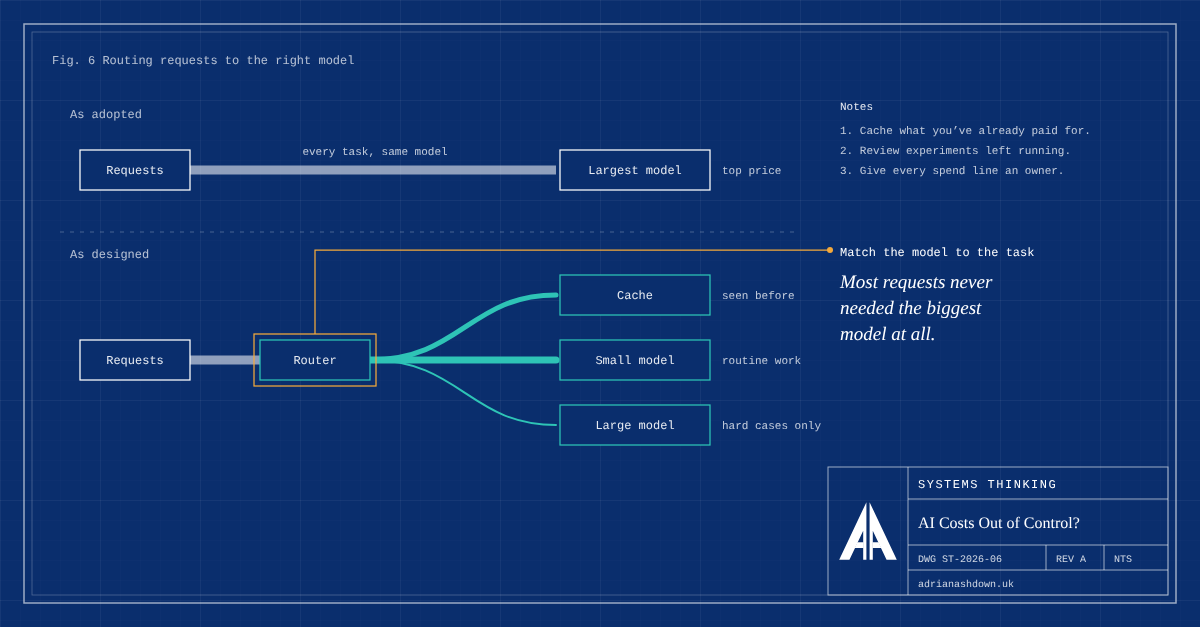
- Model choice matters enormously, and the default is usually the most expensive. It’s common to find a task running on a large model when a smaller, cheaper one would do just as well, simply because nobody revisited the choice once it worked.
- Sprawl across tools and teams. AI turns up in a chatbot subscription, a feature inside the CRM, a coding assistant and an API integration, each billed separately and each decided on its own, with nobody holding the full picture.
- Experiments that never get reviewed. A proof of concept that worked is left running in production, and nobody checks whether it’s still needed or was ever tuned for cost.
- Redundant calls and no caching. The same prompt, or something very close to it, is sent again and again, paying full price for an answer you already had.
None of this means anyone has done something wrong. It’s the predictable result of a useful technology being adopted quickly by teams focused, rightly, on what it can do rather than on what it costs at scale.
Why “just use it less” is the wrong frame
The instinctive response to a high bill is to restrict usage: cut licences, cap API calls, ask people to be careful. That helps at the margins, but it treats the symptom, and it risks throttling the very capability that made the tool worth adopting.
I find it more useful to ask a different question. Not “how do we use this less?” but “does the way we use it match the value it creates?” That tends to surface bigger, more durable savings than asking everyone to be frugal.
Where the real savings usually are
In my view, the biggest wins fall into a small number of areas:
Matching the model to the task. Not every job needs the largest, most capable model. Using a smaller model where it performs just as well is often the single biggest lever, and one of the easiest to overlook.
Caching and deduplication. Where the same or similar requests recur, storing results rather than regenerating them can cut costs substantially, especially for high-volume, low-variation work.
Leaner prompts and workflows. Unnecessary context, poorly structured prompts and chatty multi-step workflows add cost without adding value. Tightening them is usually low risk and high impact.
Consolidating tools and licences. AI adopted piecemeal across teams tends to duplicate itself. Settling on fewer, well-chosen tools reduces both cost and the overhead of managing them.
Visibility and ownership. As with cloud spend, you can’t optimise what you can’t see. Attributing AI spend to the team, product or feature responsible makes it possible to prioritise fixes and keep usage accountable.
Part of adoption, not an afterthought
The other trap is treating AI cost control as a one-off clean-up. That helps once. Then the sprawl starts again, because the underlying pattern of fast, ungoverned adoption is still there and new tools keep arriving.
The more durable fix is to build cost and architecture thinking into how AI is adopted in the first place, so “what will this cost at scale, and does it really need the most expensive model?” is asked at the start, not eight months later when the invoice is impossible to ignore.
Why it matters commercially
AI spend is no longer a novelty line item. It’s fast becoming a real input to margins, alongside infrastructure and headcount. Getting the architecture right doesn’t just reduce cost. It usually improves reliability and performance too, because the discipline that controls spend, matching the right tool to the right task and avoiding redundant work, tends to produce a better system anyway.
Taking a proper architectural look at AI usage before deciding what to cut tends to save more money, keep more of the value, and cause far less disruption than reaching for the off switch.