Originally published on Ashdown Systems in September 2026, and revised for this blog. Read the original.
There’s a particular kind of dread that sets in when a business realises it has outgrown a vendor but can’t leave. The pricing has crept up, the roadmap has stalled, or something better has come along. But switching would mean rebuilding integrations, migrating years of data and retraining the team, so you stay put and quietly resent it. That’s vendor lock-in, and almost every business has some version of it somewhere.
The instinctive response is to avoid commitment altogether: stay flexible, keep options open, never fully commit to any platform. In practice that usually backfires. Total flexibility is slow and expensive to maintain, and most businesses need to make a decision and get on with things. The real goal isn’t to avoid lock-in entirely. It’s to understand where you’re accepting it, why, and to make sure you can still move if you really need to.
Some lock-in is unavoidable, and that’s fine
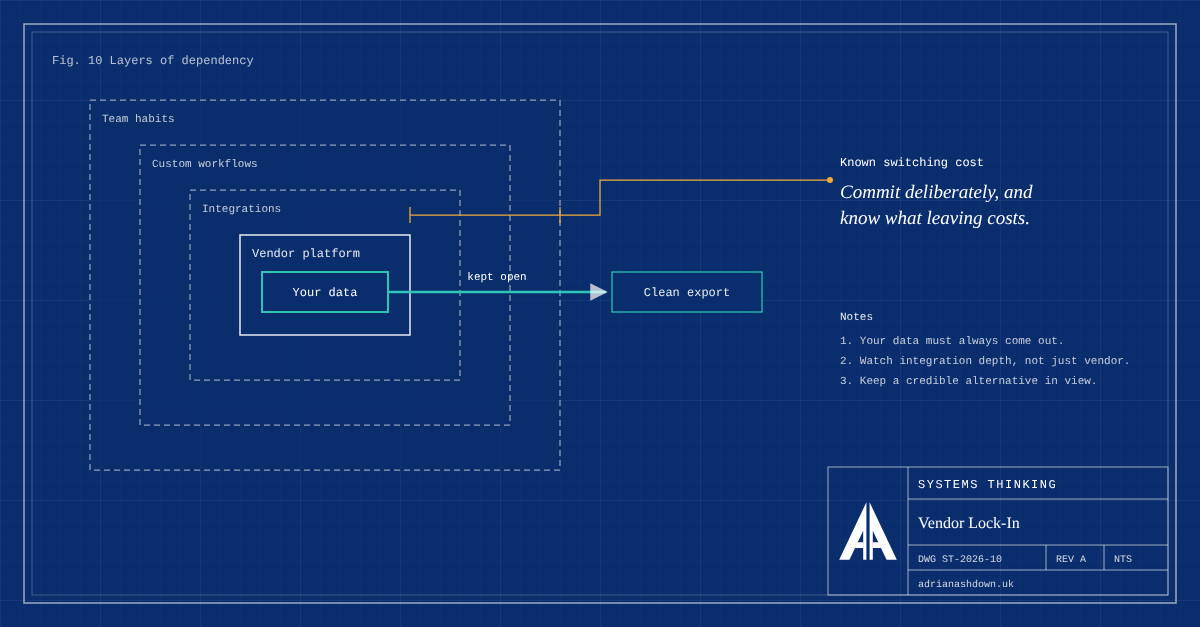
Every meaningful vendor relationship creates dependency. Your data lives in their system, your team learns their interface, and your other tools integrate with their API. That isn’t a design flaw. It’s what it means to use a platform properly rather than hedging against it for ever.
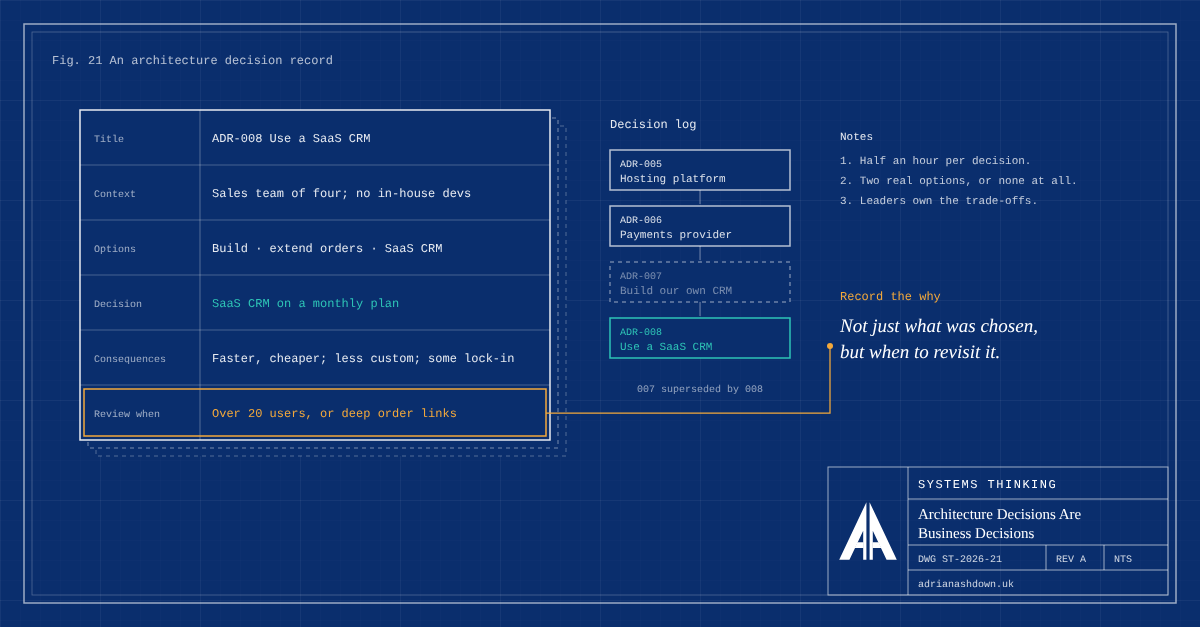
Trying to eliminate lock-in is a trap of its own. Building everything to be maximally portable, avoiding every vendor-specific feature and keeping every option permanently open adds real cost and complexity today in exchange for flexibility you may never need. Teams that go down this path tend to move slower, spend more, and still end up locked in somewhere, just less deliberately.
The useful question isn’t “how do we avoid lock-in?” It’s “where are we choosing to accept it, and is that a good trade?”
Where it quietly becomes a problem
Lock-in turns from a normal part of doing business into a real risk in a few situations:
- When nobody chose it deliberately. A tool adopted quickly under pressure, without anyone weighing the long-term commitment, can lock you in by accident.
- When your data isn’t portable. If you can’t get a clean export of your own data in a usable format, you’re not just dependent on a vendor; you’re at their mercy for something that is fundamentally yours.
- When the switching cost grows unseen. Every new integration and custom workflow built on a platform raises the cost of leaving, usually without anyone tracking it.
- When it sits in a core system. Lock-in in a supporting tool is an inconvenience. Lock-in in the system the whole operation depends on is a strategic risk.
- When the market has no realistic alternative left. If a vendor knows you have nowhere to go, pricing and service tend to reflect that over time.
Staying flexible without slowing down
Real flexibility doesn’t mean hedging on every decision. It means being deliberate about a few things up front, so you keep genuine options later without paying for them constantly in the meantime:
Know what leaving would involve before you need to. Understanding the real cost and effort of switching, even for a tool you have no plans to leave, means you’re never caught out and you know your negotiating position.
Always protect data portability. However locked in you are functionally, make sure your own data can be extracted in a usable form. It’s one of the cheapest forms of insurance available, and one of the most often skipped.
Separate core from replaceable early. Decide which systems are truly load-bearing and which are interchangeable. Core systems deserve more scrutiny and more deliberate commitment; replaceable ones don’t need the same caution.
Watch integration depth, not just vendor choice. In my experience, the real lock-in is rarely the platform itself. It’s the dozen custom workflows and integrations built on top of it over time.
Negotiate from strength, not panic. Vendors treat customers who could plausibly leave differently from those who obviously can’t. Keeping a credible alternative in view, even one you never use, changes the relationship.
Flexibility is a decision, not a default
The businesses that handle vendors well aren’t the ones that avoided commitment. They’re the ones that committed deliberately, understood the trade-off, and kept a clear enough picture of their own architecture to know what switching would cost if they ever needed to.
That isn’t a reason to slow down on vendor decisions. It’s the opposite. Knowing where you stand means you can commit to the right tool with confidence, rather than hedging indefinitely out of a vague fear of getting stuck.