Originally published on Ashdown Systems in October 2026, and revised for this blog. Read the original.
Most people running a business have a good instinctive feel for how it’s doing commercially: revenue, growth, customer numbers, cash in the bank. Far fewer have an equally clear picture of the technical foundation underneath. That isn’t a criticism. It simply isn’t what leaders are trained or expected to track day to day.
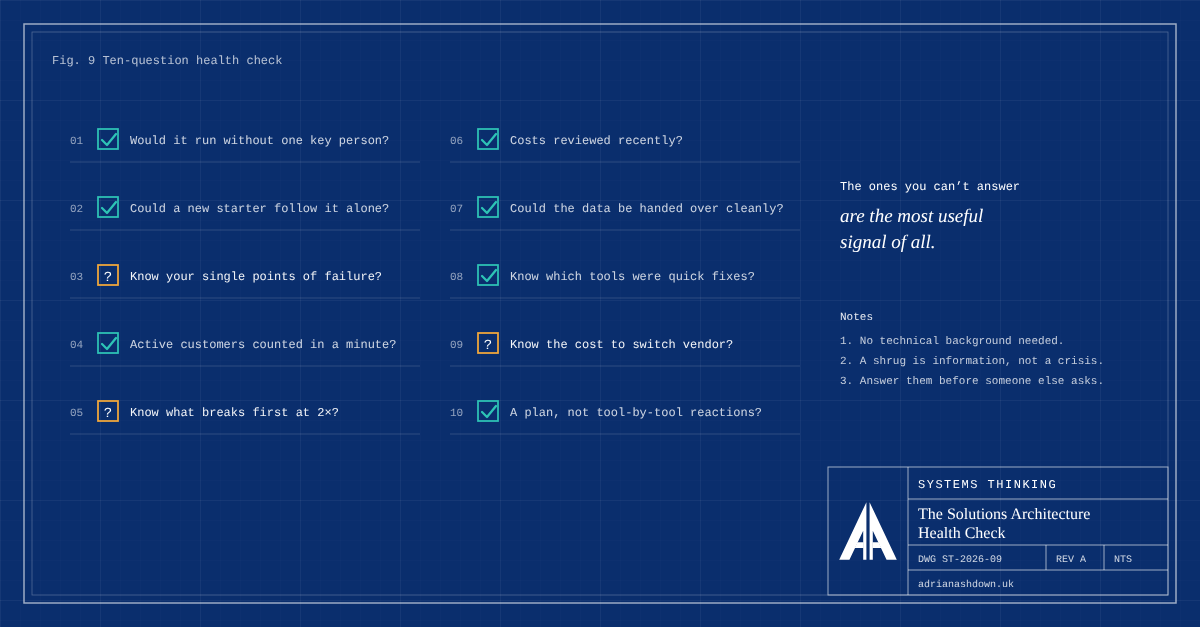
But a handful of plain questions can show, fairly quickly, whether the systems are in good shape or quietly accumulating risk. None of them need a technical background. If anything, the questions you can’t answer confidently are the most useful signal of all. These are the ten I’d ask.
1. If your most technical person left tomorrow, would the business keep running?
Every business concentrates some knowledge in one or two people. The question isn’t whether that risk exists, because it almost always does, but whether anyone is aware of it and has a plan.
2. Could a new starter understand how your systems fit together without asking three different people?
If the answer depends on knowledge scattered across the team rather than something written down, that isn’t a hiring problem. It’s a sign that the design of your systems lives in people’s heads.
3. Do you know where your single points of failure are?
One server, one integration, one manual process that everything else depends on: most businesses have at least one. The ones at risk aren’t those with a single point of failure. They’re the ones that don’t know they have one.
4. Could you say how many active customers you have in under a minute?
Simple operational questions should have simple, fast answers. If getting a clear number means cross-referencing several systems or chasing several people, there’s a data silo costing more than you’d guess.
5. If you doubled in size next year, what would break first?
Not whether something would break, because something always does, but whether you know what. Leaders who can name their likely breaking point are already ahead of those who’d find out when it happens.
6. When did you last review what your tools and infrastructure actually cost?
Costs creep quietly, especially for cloud and AI services priced on usage. If nobody has looked properly for a while, there’s a fair chance you’re paying for waste you don’t know about.
7. Could you hand over your customer and business data cleanly if you had to?
Whether to a new tool, an auditor, an investor or a buyer, this is a good proxy for how healthy the data really is. If the honest answer is “it would take weeks to untangle”, that’s better known now than discovered under pressure.
8. How many of your tools were adopted under time pressure, without much evaluation?
Every growing business does this. But knowing roughly how many systems were quick fixes rather than deliberate choices gives a sense of how much hidden technical debt you’re carrying.
9. Do you know what it would cost to move away from your most important vendor?
You don’t need to switch. But not knowing the answer means you don’t know your own negotiating position, or whether that cost has quietly grown to an uncomfortable size.
10. Is there a plan for your technology, or is it decided reactively, tool by tool?
This is the question that ties the others together. With a plan, each new tool or system is chosen in the context of where the business is heading. Without one, each decision is made in isolation, and you end up with the sum of nine separate “good enough for now” calls.
What the answers tell you
If you answered most of these confidently, that’s a good sign. You probably have a clearer picture of your technical foundation than most businesses of your size. If several answers were a shrug, that isn’t a crisis. It’s simply information nobody has gathered and organised yet, and gathering it is exactly what an architectural review is for.
For me, the value of the exercise isn’t the score. It’s that leaders who can answer these questions make faster, better decisions about hiring, growth, funding and which fires are actually worth fighting first. Those who can’t tend to find out the hard way, usually at the worst possible moment.