Originally published on Ashdown Systems in September 2026, and revised for this blog. Read the original.
Ask most people running a business whether they have a “data silo problem” and they’ll say no. Ask whether two systems ever disagree about a customer’s order history, or whether someone spends part of each week copying numbers from one place to another, and the answer is usually yes. That gap between not recognising the term and living with the symptom every week is why data silos are one of the most under-diagnosed costs in a growing business.
A data silo isn’t a technical failure. It’s simply information trapped in one system, unable to reach the other systems that need it unless someone moves it by hand. Every business has a few. The question is whether you know where yours are and what they cost.
Why silos form when nobody gets anything wrong
Silos are rarely the result of poor planning. They’re the natural outcome of normal growth:
- Each department picks the tool that solves its own problem, with no requirement to think about how it connects to anything else.
- Tools arrive at different times, chosen by different people for different reasons, and nobody coordinates the whole picture.
- “We’ll just export it to a spreadsheet for now” becomes a permanent, invisible process.
- Systems that could integrate never do, because there wasn’t the time or budget to set it up properly.
Each of those decisions made sense on its own. The silo is what you get when you add them together and nobody looks at the total.
Six signs you have a silo problem
Silos rarely announce themselves. They show up as small, recurring frustrations that come to be accepted as “just how things are”. Some of the clearest signs:
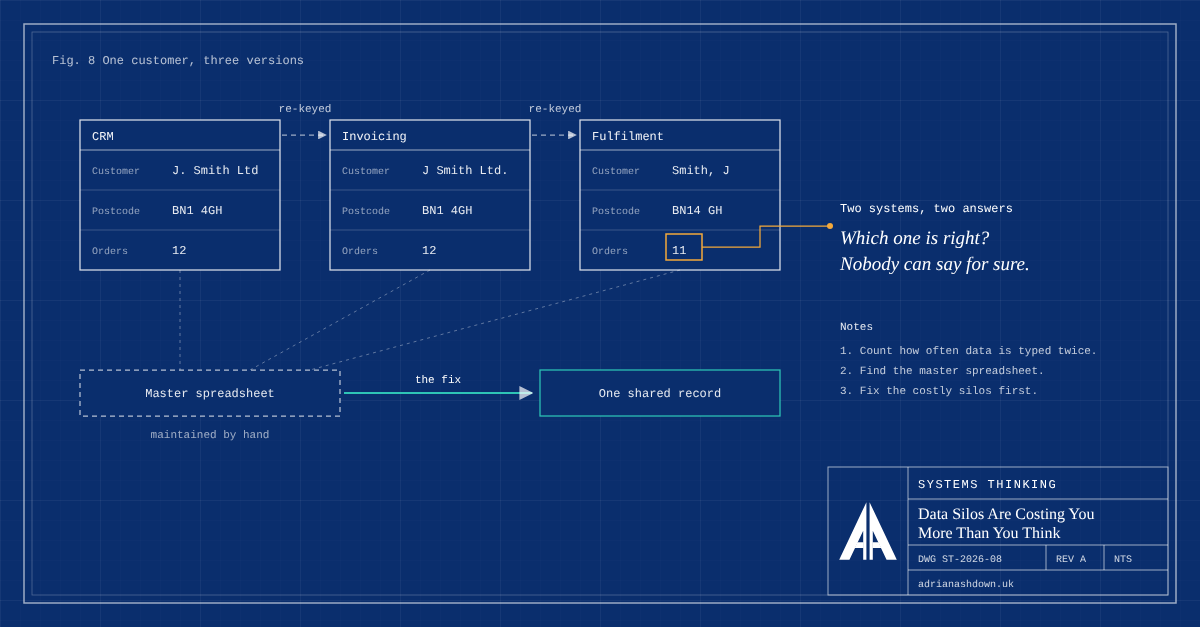
1. The same information is typed in more than once. A customer’s details go into the CRM, then into invoicing, then into the fulfilment tool. Each entry is a chance for a typo and a slice of someone’s time that shouldn’t be needed.
2. Two reports never quite agree. Finance has one figure for monthly revenue and sales has another, and nobody can say with confidence which is right, because they draw on different sources.
3. A “master spreadsheet” holds the business together. Someone maintains it by hand, stitching together data that ought to flow on its own. It works, but everyone quietly knows it’s fragile.
4. Simple questions need several people and several systems. “How many active customers do we have?” should take seconds. If it means asking three people and cross-checking two tools, that’s a silo, not a minor inconvenience.
5. New starters take weeks to learn “how things really work”. If onboarding is full of “and you also need to check this other system for that”, knowledge of how the data connects lives in people’s heads rather than in the systems.
6. Decisions stall because nobody trusts the numbers. This is the most expensive sign. When leaders hesitate because the data feels unreliable, that isn’t caution. It’s the silo actively slowing the business down.
If two or three of these sound familiar, there are almost certainly silos costing more than you’d guess.
What silos actually cost
Each symptom looks small: a few minutes here, an awkward report there. Added up across a team over a year, the costs rarely are:
- Time. Re-keying and reconciliation are a real, recurring cost, even though they never appear as a line item.
- Accuracy. Every manual hand-off is a chance for data to drift or drop out, and those errors tend to surface at the worst moments: a customer complaint, a failed audit, a board question nobody can answer cleanly.
- Speed of decisions. Connected businesses answer questions in minutes. Siloed ones spend that time reconciling first, and often decide on worse information anyway.
- Growth capacity. Manual processes that just about cope with a small team become unworkable as volume grows, right when the disruption of fixing them is least affordable.
Spotting them is the easy part
The signs above are usually visible to anyone paying attention. The harder part is deciding what to do about them. Not every silo needs the same fix. Some need a better integration between two existing tools, some point to a real gap in how the business’s data is structured, and a few aren’t worth fixing at all compared with what they cost.
For me, that prioritisation is where an architectural view helps most. It turns a list of everyday frustrations into a clear, ranked plan: what to connect first, what to leave alone, and what a well-designed flow of data should look like for a business of that size.